(A Practical Guide for Growing Shows)
Most serious podcasters hit the same moment at some point:
“I thought I just needed an editor – or maybe some AI tools – but now I’m managing files, feedback, versions, clips, exports, and delivery every week.”
That’s usually a strong signal it might be time to outsource post-production – not because you can’t do it yourself, but because it’s quietly starting to take time away from the parts of podcasting you actually care about:
• Conversations
• Ideas
• Guests
• Audience
• Strategy
Most people don’t start a podcast because they want to manage production workflows, but as soon as episodes become consistent, production complexity usually increases – whether you planned for it or not.
Most serious creators don’t want to become production managers, but traditional production setups quietly push you into technical and operational roles.
You end up managing:
Recording tools
File transfers
Storage
Feedback systems
Editor communication
Publishing coordination
That’s not really podcasting.
That’s production operations.
And for many growing shows, that’s the moment where outsourcing stops feeling like a “nice to have” – and starts feeling like the logical next step.
If podcasting is mainly a hobby for you, it’s completely reasonable to keep costs low and handle editing and content creation yourself.
But if your podcast is tied to your business, brand, or growth, the conversation usually changes pretty quickly.
If your podcast supports things like:
• Your business
• Your personal brand
• Lead generation
• Authority building
• Partnerships
• Community growth
Then reliability usually matters more than small differences in editing cost or software pricing.
At that stage, podcast post-production isn’t just about getting episodes edited.
It’s about having a production workflow you can rely on – week after week – whether you’re working with a podcast editing service, internal team, or outsourced post-production partner.
If your podcast drives revenue or authority, one missed release usually hurts more than saving £50 on editing.
Consistency builds trust.
Trust builds audience.
Audience builds business outcomes.
And once consistency becomes business-critical, many teams start asking a different question:
Not:
“Can we keep managing podcast editing and post-production ourselves?”
But:
“Should we still be managing this manually – or should we outsource podcast post-production so it runs predictably?”
There is no single “right” way to produce a podcast.
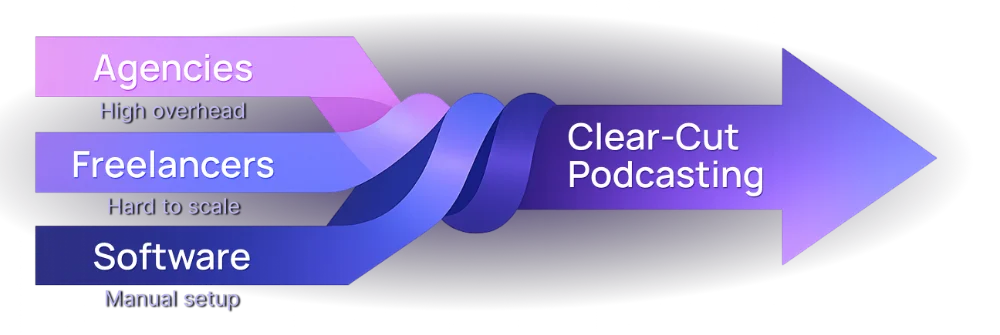
Agencies, freelancers, and software tools all exist for good reasons.
But each comes with trade-offs – especially once you start caring about consistency, scale, and time.
Where agencies are strong
 High production quality Strategy + creative direction included Full service (often across multiple content channels) Low learning curve for the client
Where agencies can become difficult
 Expensive for ongoing weekly production Often still rely on multiple third-party tools behind the scenes You may still upload files, review elsewhere, manage feedback externally Less flexible for smaller or fast-moving shows
Agencies are excellent if budget is secondary and you want a premium, hands-off service.
But they don’t always remove operational complexity – they often just absorb part of it.
Where freelancers are strong
Cost-effective (especially early stage) Direct relationship with the person doing the work Can be extremely high quality if you find the right one Flexible and fast for specific tasks
Where freelancers become risky
Great ones are hard to find Hard to scale as your show grows Usually still heavy on email + cloud drive workflows Process quality depends on the individual, not a system
Freelancers are often the best starting point.
But as production volume grows, coordination overhead usually grows too – and that’s often when teams start considering outsourced production systems instead of individual help.
Where software is strong
Low cost Fast to start Powerful recording features Full control if you’re technical
Where software becomes work
You become the production manager You still need to manage recording quality, files, editing workflow, feedback, publishing Requires time + technical confidence Easy to underestimate total production effort
Tools are incredibly powerful.
But they assume you want to own production operations yourself – and that’s not always realistic once a podcast becomes part of a business or brand growth strategy.
Most growing podcasts don’t actually want:
• Agency-level cost
• Freelancer dependency risk
• DIY production management
They want:
Reliable output
Predictable workflow
Professional quality
Low operational overhead
That’s the gap modern production partner models are designed to fill.
A real production partner doesn’t just edit files.
They reduce production decision fatigue.
They standardize workflow.
They remove tool-juggling.
They create predictable output.
And for many growing podcasts, outsourcing production isn’t about losing control – it’s about removing operational noise.