Video podcasts aren’t new.
They’ve existed on YouTube, Spotify, and technically inside Apple Podcasts for years.
So the recent attention isn’t about adding video.
It’s about something deeper:
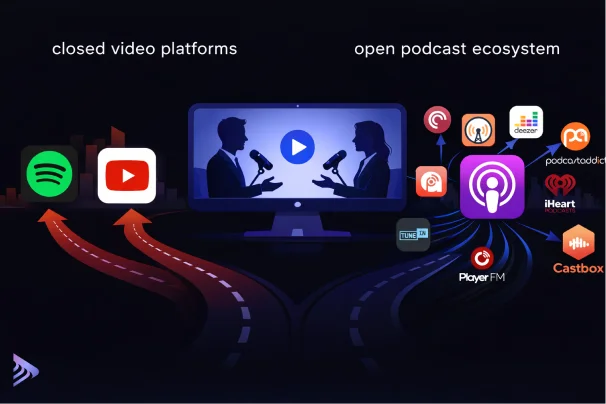
bringing video back into the open podcast ecosystem instead of forcing it into closed platforms.
That changes who controls distribution – and how podcasts are produced.
The Old Structure: One Open System, One Closed System
For most of modern podcasting, creators unknowingly operated across two infrastructures.
The open podcast system (RSS-based)
subscription-driven
routine listening
audience ownership
universal distribution across apps
The closed video platforms
algorithm-driven discovery
platform-controlled visibility
strong viewing experience
locked audiences
The practical outcome:
The episode lived on YouTube.
The audio lived in podcast apps.
Video existed – but not inside the podcast environment in a comfortable way.
Creators adapted their workflow around the split:
record → edit audio → publish → upload video elsewhere → cut clips
The show itself became fragmented across systems.
What Apple Is Actually Changing
Apple isn’t inventing video podcasts. They’re making them usable inside the open RSS ecosystem.
Historically, video episodes behaved like downloadable files:
slow buffering
heavy storage
unreliable playback
Listeners avoided them.
Apple is improving playback, caching, and in-app viewing so video behaves like a normal episode rather than an attachment.
Watching no longer requires leaving the podcast environment. The listener doesn’t switch platforms to watch – only to discover.
The Key Clarification: Video Was Always Open – Just Unusable
Apple always supported video through RSS. Any compatible podcast app could technically play it.
The problem wasn’t availability – it was usability.
Large downloads, buffering, battery usage, and storage made listeners avoid video episodes.
So creators moved video to YouTube because:
closed platform + great playback beat open platform + poor playback
Apple’s change makes open video consumption feel like modern streaming – making the open ecosystem competitive again.
Why This Matters Beyond Apple
If video consumption becomes comfortable inside podcast apps, the RSS ecosystem upgrades together:
multiple apps can support it
creators publish once
audiences choose where to consume
The competition shifts from:
platform vs platform
to
open ecosystem vs closed ecosystem
From Platform-Centric to Episode-Centric
Previously:
YouTube = viewing
podcast apps = audio
social = clips
Now:
podcast apps = watch or listen
YouTube = discovery
social = amplification
The episode becomes the main product again.