
Most podcasts don’t fail because the host lacks ideas.
They fail because the podcast production process becomes heavier than the motivation to keep going.
At the start, podcasting feels simple:
a mic, a conversation, maybe a rough edit – and you’re live.
Then reality kicks in.
It’s Not a Motivation Problem
People love to say:
“Most podcasters quit because they lose motivation.”
That’s lazy thinking.
Motivation doesn’t disappear on its own.
It disappears after friction piles up.
Nobody stops podcasting because they suddenly hate their topic.
They stop because every episode turns into a small project-management problem.
Here’s what slowly kills momentum for most podcasters:
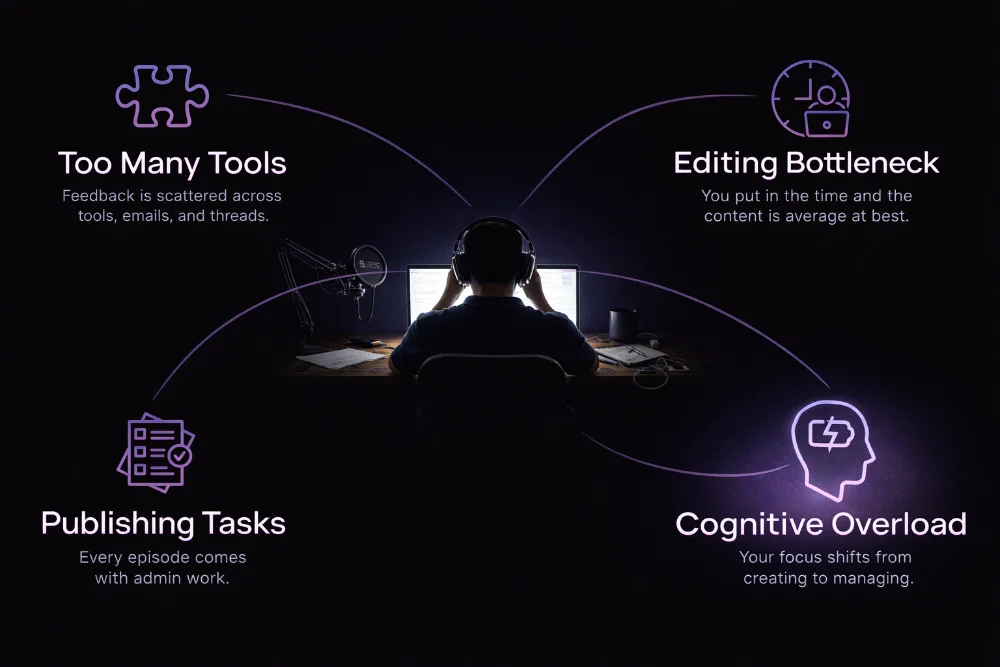
1. Too Many Tools
Recording in one app.
Sending files via Google Drive or WeTransfer.
Leaving feedback in email or WhatsApp.
Publishing somewhere else entirely.
Each step on its own is manageable.
Together, they create a fragmented podcast workflow that drains energy.
2. Editing Becomes a Bottleneck
At first, you edit the podcast yourself.
Then you outsource podcast editing.
Now you’re:
You put in the time – but the content is average at best.
The episode exists, but it’s never truly finished.
3. Feedback Is Friction, Not Collaboration
Most podcast workflows treat feedback as an afterthought.
Comments get lost.
Notes are vague.
Revisions feel risky: “If I ask for one more change, will they charge me?”
So podcasters settle.
Or worse – they stop caring about quality.
4. Publishing Feels Like Homework
Uploading files.
Checking formats.
Writing titles and descriptions.
Adding artwork.
Scheduling the episode.
Podcast publishing isn’t hard – it’s just annoying enough to delay.
And delayed episodes quickly become skipped episodes.
The Real Problem: Cognitive Overload
Podcasting gets stuck when it stops being creative and starts being administrative.
You’re no longer asking:
“What should the next episode be about?”
You’re asking:
That mental load compounds.
Week after week.
Skipping one episode becomes skipping three.
Then six.
Then: “I’ll come back to it later.”
The Podcasts That Survive Have One Thing in Common
They reduce friction ruthlessly.
Not by working harder.
Not by being more disciplined.
But by removing:
They make podcast production and publishing feel boring – and that’s a good thing.
This exact problem is why we built Clear‑Cut Podcasting.
Not as “another podcast editor.”
Not as “another tool.”
But as a single, all-in-one podcast production workflow where:
No email chains.
No guessing what’s final.
No juggling platforms.
Just a repeatable system that lets you focus on what actually matters:
having great conversations and showing up consistently.
Because most podcasts don’t die from lack of passion –
they die from unnecessary friction.
